Addendum 22.18.a, Concave and convex mirrors, to
22.18, The Moon and the Implications of Its Satellite Position
Concave and convex mirrors
Virtual and realistic images
Curved mirrors can show both virtual and realistic images, depending on the distance between the object to focal point and the center point. They can show images that appear to be behind the mirror’s surface, as we know from our daily lives, but they can also show realistic images, which appear to be in front of the mirror surface.
So curved mirrors offer more than one form of reflection.
In the case of concave and convex mirrors, each of these can generate seven different forms (*). Two of them are illustrated below.
The concave mirror
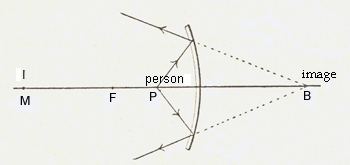
fig. 22.18.a.1 The virtual image in a concave mirror
In a virtual image, person P stands between the midpoint M of the mirror’s curvature and its focal point F. Behind the mirror, the person sees an image B of himself which is reflected back to him at a magnified angle. In this case, the person does not stand in his own center, but lives within the self-view offered to him by the sphere of influence of this enveloping mirror effect.
In a real image, the person P stands behind the focal point F and also behind the midpoint M of the mirror’s curvature.
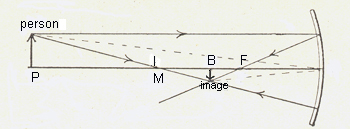
fig.22.18.a.2 The realistic image in a concave mirror
In this case, the person stands beyond the mirror’s sphere of influence and is therefore able to use it as an instrument.
Other mirror images
Other mirror images in concave mirrors arise when:
3. the person stands at an infinite distance. In that case, the real image B coincides with the focal point F.
4. the person stands in the middle of the mirror curvature. In this case, the real image also coincides with M. In other words, it become conjunct with the Self.
5. the person stands between the midpoint M and the focal point. In this case, the real image arises behind the midpoint M.
6. the person stands in the focal point F. In this case, the light rays are reflected back as a parallel bundle. The real image is at an infinite distance and therefore no longer determinable.
7. the person has been projected (by means of a second mirror) behind the mirror. In this case, the real image arises between the mirror and the focal point.
-.-.-.-.-
The convex mirror
A person looking into a convex mirror does not stand at the same side as the midpoint and the focal point. That is why a convex mirror always generates a virtual image of any real object or person in front of it.

fig 22.18.c The virtual image in a convex mirror
Person P will see a reduced image of the environment (and of himself). He sees the objective world as a part of his own virtual reality. In other words, this kind of mirroring always has a diverging effect.
Other mirror images
The other mirror images in a convex mirror arise when:
2. the person stands at an infinite distance. In this case, the image coincides with the focal point F.
3. the person (projected by means of a second mirror) stands between the mirror and its focal point
4. the (virtual) person stands in the focal point
5. the (virtual) person stands between the focal point and the midpoint
6. the (virtual) person stands in the midpoint
7. the (virtual) person stands behind the midpoint.
All these forms of mirroring represent certain specific focal adjustments of the Moon, whose potential psychological capacity is therefore impressive.
index, subjects per page, pictures, blue marked texts, references, tables and overviews, courier, forum